

In the Company of Shepherds
Long before dawn breaks over the Banni grasslands of Kachchh, the Rabari pastoralists are already moving. Wool-wrapped against the cold, they guide their flocks—thousands of sheep and goats—across landscape that shifts between green abundance and parched survival depending on the mercy of monsoons.
The landscape here operates on elemental terms. Horizons stretch uninterrupted to the curve of the earth.

Credit: Bannigrasslands.org [Link]
In summer, the ground cracks into geometric patterns of desiccation; in monsoon (when it comes), the entire Banni plain transforms into shallow wetland where flamingos descend in pink clouds. Wind is constant—carrying salt from the Little Rann, dust from distant deserts, the smell of wild basil and lantana crushed under hooves.

Credit: Bannigrasslands.org [Link]
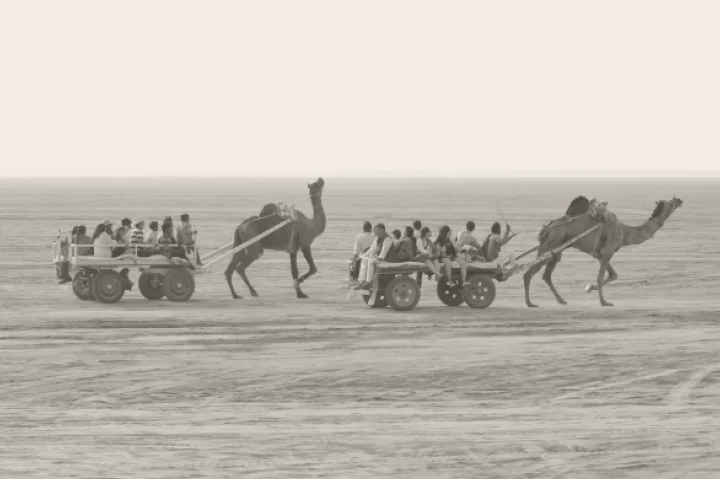
This is the oldest conversation in the region: between human, animal, and earth. The Rabari have been pastoral nomads here for centuries, following water and grazing land, carrying their entire material culture on the backs of camels. Their wool—sheared, handspun, and woven into textiles of remarkable resilience—is not a byproduct of herding. It is the reason for it.
The Pastoralist series traces this lineage. Each throw begins not in a workshop but in open country, where sheep graze on wild grasses and medicinal herbs that will eventually influence the quality of their fleece.
What the Land Puts Into the Fibre
The Banni grasslands aren't just backdrop—they're architect. This 3,800 square kilometer expanse of arid grassland creates a harsh botanical ecosystem where only the hardiest plants survive. The indigenous sheep here graze on a distinct palette:
Cenchrus grasses, Suaeda salt-tolerant shrubs, wild senna, and seasonal herbs that emerge after monsoons.
 Credit: Bannigrasslands.org [Link]
This diet directly influences fiber characteristics. The high protein content from leguminous plants strengthens the keratin structure. The minerals absorbed from salt-tolerant vegetation increase crimp and elasticity. The variety of browse—switching between grasses and shrubs as seasons demand—produces fiber with greater variation in diameter along each strand, which contributes to the loft and air-trapping capacity that makes Kachchh wool exceptionally insulating without weight.
The temperature swings you feel in the throw? That's not metaphor. These sheep developed fleece that creates micro-climate regulation through a combination of coarse outer fibers that shed dust and moisture, and finer undercoat that traps warmth. The fiber literally evolved to solve the same thermal problem your home faces—maintaining comfort across dramatic temperature variation.
Wool That Works For You

In your home, this translates to practical benefits: a throw that keeps you warm without overheating, that resists stains and odors naturally, that improves with age rather than deteriorating. These properties inherent to wool evolved in extreme conditions.
The fiber structure creates air pockets that insulate in cold while remaining breathable in warmth. You can use these throws year-round—layered on beds in winter, draped on sofas in summer—because the same micro-climate regulation that protects sheep works for you.
Wool's natural lanolin coating and the crimp in the fiber prevent dirt and moisture from penetrating. Coffee spills bead on the surface. Pet hair shakes off. The antibacterial properties mean odors don't accumulate. These throws need washing perhaps once or twice annually, not weekly.
Each strand retains moisture even when dry, preventing brittleness. What you experience as "developing a patina" is actually the wool achieving its ideal balance of softness and strength through use—breaking in like leather, not breaking down.
Dust mites, a primary trigger for asthma and allergies, cannot survive in wool's moisture-wicking environment. For sensitive sleepers or homes with children, this matters more than thread count.
These qualities exist because Kachchh sheep aren't bred for softness—they're bred for survival in conditions that would destroy delicate fibers. They produce wool that can withstand extreme temperature swings, that sheds dust naturally, that keeps warmth close in winter and somehow remains bearable even in heat.
When you handle a Pastoralist throw, this is what you're feeling: fiber shaped by climate extremes, evolved through generations to serve pastoral communities who sleep under stars and wake to frost, who need textiles that function as shelter, warmth, and home.
The wool comes primarily from two indigenous breeds: Patanwadi sheep, endemic to Kachchh's Banni region until recent decades, producing wool with excellent crimp and durability; and Marwari sheep, distributed across Rajasthan's arid zones, known for coarser, more lustrous fiber ideal for textiles requiring structure without weight.
Both breeds are fat-tailed—storing energy reserves in large tails that allow them to survive extended dry periods when grazing is sparse. This adaptation to food scarcity also influences fiber: the protein cycling between tail fat reserves and wool growth creates fiber with variable diameter that enhances loft and resilience.
After shearing in late winter, the wool is washed in natural water sources, then laid in sun until it achieves the particular dryness that makes it spin true.
The Physics of Hand-spinning

In villages like Khavda and Dhordo, women gather in courtyards to spin. Not on wheels—those came later and are still viewed with some suspicion—but with the takli, a simple wooden spindle that hangs suspended from a thread, spinning under its own momentum while the spinner feeds wool fiber from a bundle tucked under her arm.

Watch skilled Rabari women who have been spinning since childhood, and you'll see something close to meditation. Their hands move in continuous rhythm—draft the fiber, give the spindle a twist, let it spin, wind the yarn, repeat.
This is why handspun wool carries a different character than mill-spun. The slight irregularities in thickness create textiles with more air, more loft, more capacity to trap warmth without weight. The twist is gentler, leaving the fiber less compacted. The result is wool that breathes, that doesn't make you overheat, that somehow manages to regulate comfort in temperature ranges where other textiles fail.
Colors That Need No Apology

The Pastoralist palette is deliberately restrained: undyed natural wool in shades from cream to charcoal.
This isn't minimalism as aesthetic choice. It's minimalism as respect for material. Wool this carefully produced, handspun this slowly, doesn't require elaborate pattern or vivid color to announce its value. The texture itself—the visible character of handspun yarn, the way light catches the slight irregularities—provides all the visual interest needed.
The Rabari have always understood this. Their traditional textiles prioritize durability and function over decoration. A throw might last twenty years, passed between family members, gathering the patina of use. Loud colors and complex patterns would compete with this accumulation of life. Better to let the wool speak its own language.
The Rarity of Unbleached Brown
Among Kachchh’s pastoral flocks, a small percentage of sheep carry genes for naturally pigmented fleece—wool that grows in shades of chocolate, taupe, and deep earth brown without any dyeing required. These aren’t separate breeds but genetic variations within Patanwadi and Marwari populations, expressing a recessive trait that produces melanin-rich fiber.
This brown wool represents less than 15-20% of most flocks. Pastoralists traditionally preferred white wool for its versatility in dyeing, so brown-fleeced animals were often culled or their wool considered secondary. The Rabari, however, recognized what this pigmented fiber offered: complete elimination of the dyeing process.
Zero-Water Luxury
The environmental calculus is straightforward. Dyeing one kilogram of wool consumes approximately 60-100 liters of water and generates chemical wastewater requiring treatment. In the Banni grasslands, where water is drawn from shared virdis and seasonal catchments, this matters profoundly.
Naturally brown wool skips this entire chain. The fiber goes from shearing to washing to spinning to weaving without touching a dye bath. No synthetic colorants, no mordants, no effluent. The color you see is keratin protein with melanin pigmentation—the same biological chemistry that colors human hair.
For water-stressed regions like Kachchh, this isn’t a small benefit. It’s the difference between craft that depletes local resources and craft that works within ecological limits.
The Palette of Un-intervention
The brown tones vary—some skeins emerge deep chocolate, others softer taupe, depending on individual sheep genetics and the season’s grazing. This variation isn’t a defect; it’s documentation of genetic diversity within the flock.
Spring shearing, after monsoon grazing on protein-rich grasses, tends to produce richer pigmentation. Summer wool, grown during sparse forage, often comes lighter. The handspinner works with what each fleece offers, blending subtly or keeping individual sheep’s wool separate depending on the final textile’s requirements.
In your throw, these brown tones might appear as solid fields of color or combined with natural cream wool in striped patterns—the traditional Rabari approach to showcasing both color variations within a single piece.
Conservation Through Diversity
Maintaining naturally pigmented sheep within pastoral flocks preserves genetic variation increasingly rare in industrial sheep breeding, which heavily favors white wool for commercial dyeing. These brown-fleeced animals represent genetic material adapted to Kachchh’s specific environmental pressures over centuries.
When handspinners work with brown wool, they’re making visible a form of biodiversity that would otherwise remain economically invisible. The fiber becomes an argument for maintaining diverse genetics within herds rather than selecting solely for white fleece.
This is conservation without sentimentality—supporting the economic value of genetic traits that industrial agriculture has bred away, ensuring pastoral communities have incentive to maintain the full spectrum of their traditional flock diversity.
Limited By Nature
We cannot produce brown wool throws on demand. Availability depends entirely on annual shearing yields from naturally pigmented sheep in partner flocks. Some years produce more, some less, based on breeding outcomes we don’t control and wouldn’t want to.
This scarcity is honest—rooted in biology and pastoral practice, not manufactured exclusivity. When brown wool is available, we work with it. When it’s not, we wait. The alternative—pressuring herders to breed specifically for brown fleece or importing dyed-brown wool and calling it natural—would undermine everything this series represents.
From Pit Loom to Philosophy
The weaving happens on traditional pit looms in villages connected by dusty roads that disappear during monsoon. The weaver—often the husband of the woman who spun the yarn—sits above the pit with his feet working the pedals below, creating the shed through which the shuttle passes.
The width is determined by arm span. The pattern, if any, is carried in the weaver's memory—geometric arrangements that have been woven here since before anyone thought to write them down. There's no computer program, no written instructions. Just the knowledge passed from father to son, adjusted slightly by each generation while preserving the fundamental logic.
Jentilal, who weaves in Bhujodi, puts it simply: "You cannot rush wool. It will tell you when the tension is wrong, when the beat is too hard. You must listen."
Grasslands Need Grazers - The Conservation you’re Supporting
Here's what most people don't know about Kachchh's ecosystem: the grasslands require grazing to survive. Without regular browsing by sheep and goats, invasive Prosopis juliflora (mesquite) takes over, converting diverse grassland into impenetrable thorn forest. The Banni grasslands have lost significant native vegetation cover in recent decades, precisely as pastoral herds declined.

Credit: Wiki Commons [Link]
Sheep aren't just living on this land—they're actively maintaining it. Their selective grazing controls woody invasion. Their hooves break soil crust, allowing water infiltration and seed germination. Their dung fertilizes and disperses native seeds. Research by the Centre for Pastoralism documents that areas with active grazing support significantly more plant species diversity than abandoned grazing lands.
This is mobile carbon sequestration in action. Healthy grasslands store substantial terrestrial carbon—comparable to forests but more resilient to climate change. When you support pastoral wool production, you're funding landscape-scale conservation that maintains groundwater recharge, provides habitat for declining grassland bird species (critically endangered Great Indian Bustard, Houbara Bustard), and preserves genetic diversity in indigenous sheep breeds adapted to climate extremes.
The alternative—imported wool from industrial sheep farming in Australia or New Zealand—supports monoculture grazing systems that contribute to soil degradation and require chemical inputs. Kachchh pastoral wool is regenerative by design: low-input, low-waste, maintaining biodiversity while producing fiber.
Every Pastoralist throw represents wool from sheep grazing Banni grasslands for a season, consuming invasive species, fertilizing soil, maintaining the ecosystem that supports numerous species of mammals, birds, and countless invertebrates. This is conservation through use—the opposite of setting land aside. The Rabari presence on these grasslands, enabled by economic viability of their wool, is what keeps the ecosystem intact.
Textile as Shelter
The Rabari traditionally used these wool throws as guddi—multipurpose textiles that function as blanket, mattress, room divider, impromptu tent, and occasionally shroud. One textile, many lives, designed for people whose homes are temporary and whose possessions must justify the space they occupy.
This utilitarian origin explains the generous dimensions—large enough to wrap around two people, thick enough to cushion sleep on hard ground, substantial enough to block wind. But it also explains the surprising sophistication. When your entire material culture must be portable, every object becomes an opportunity for beauty within function.
The border patterns, the occasional stripes, the careful finishing at edges—these aren't ornamental. They're the weaver's assertion that even necessary objects deserve attention, that utility and dignity can share the same cloth.
What Survives in Modern Hands

Our Pastoralist series preserves this lineage while acknowledging contemporary use. You're probably not sleeping on the ground or using this throw as a tent. But the original qualities—the breathability, the warmth-without-weight, the durability that improves with age—translate beautifully to modern life.
Thrown across a bed, layered on a sofa, wrapped around shoulders during cool evenings, these throws carry their pastoral origins lightly. The handspun texture provides visual and tactile interest that mill-produced textiles cannot replicate. The natural colors work with rather than against contemporary interiors. Its lightweight, compact nature suggests warm, breathable comfort for daily living. It's not precious, it's meant for rugged use. Something permanent in a world of disposable goods.
And there's something else—harder to quantify but impossible to ignore. These throws carry a particular quality of groundedness, of being connected to fundamental human activities: tending animals, processing fiber, making shelter. In an increasingly digital, dematerialized world, that connection to ancient practices feels less like nostalgia and more like necessity.
Living with Wool

Above: Same throw, after seven years of use in camping, hiking, picnicking, and Netflix binging
A note on care, because these throws are meant for use, not preservation:
Wool wants air and occasional sun. It doesn't want frequent washing. Shake it out, let it breathe, spot-clean when necessary. Over time, it will develop a patina—a particular softness and drape that only comes from years of being lived with. This isn't deterioration. It's the textile becoming itself.
The handspun character means occasional loose fibers are normal, not defects. The slight irregularities in weave density are signatures of human hands, not quality control failures. If you're seeking machine perfection, this isn't your textile. But if you're seeking material with character, with story, with the accumulated knowledge of pastoral communities woven visible—this is it.

The Pastoralist | Series 01
Handspun Wool Throws | Rabari Pastoral Tradition | Kachchh, Gujarat
GI No. 174 Protected Craft | Natural Wool | Traditional Pit Loom Weaving
Discover the collection—where pastoral tradition meets contemporary sanctuary, where flock becomes textile, where every thread remembers the grasslands.
References & Further Reading
Ecological Research:
• Centre for Pastoralism field documentation on Kachchh grazing systems and biodiversity
• IUCN Red List documentation on grassland species conservation status
• Desi Oon Hub resource library on pastoral ecosystem services: desioonhub.org/wool-pastoralism
Fiber Properties & Breed Information:
• National Bureau of Animal Genetic Resources breed registry: Patanwadi (Registration #174), Marwari breeds
• Woolmark Company research on natural fiber performance characteristics
• Desi Oon Hub wool properties documentation: desioonhub.org/wool-pastoralism
Cultural Documentation:
• Centre for Pastoralism oral history archives (Rabari community interviews)
• Geographical Indications Registry of India: GI Application No. 174 (Kachchh handspun wool textiles)
Conservation Context:
• Gujarat Ecological Education and Research Foundation reports on Banni grassland vegetation change
• Academic research on mobile pastoralism and carbon sequestration in arid grasslands
All artisan names and production details based on direct collaboration with Bhujodi weaving cooperatives and Kachchh pastoral communities.
• • •

